B2C Audience Segmentation: From Rules of Thumb to AI-Powered Prediction
Most B2C brands segment their email lists using purchase recency rules or demographic filters, then wonder why engagement rates keep declining. The problem isn’t segmentation itself—it’s that traditional methods miss the complex behavioral signals that predict who will actually buy.
TLDR:
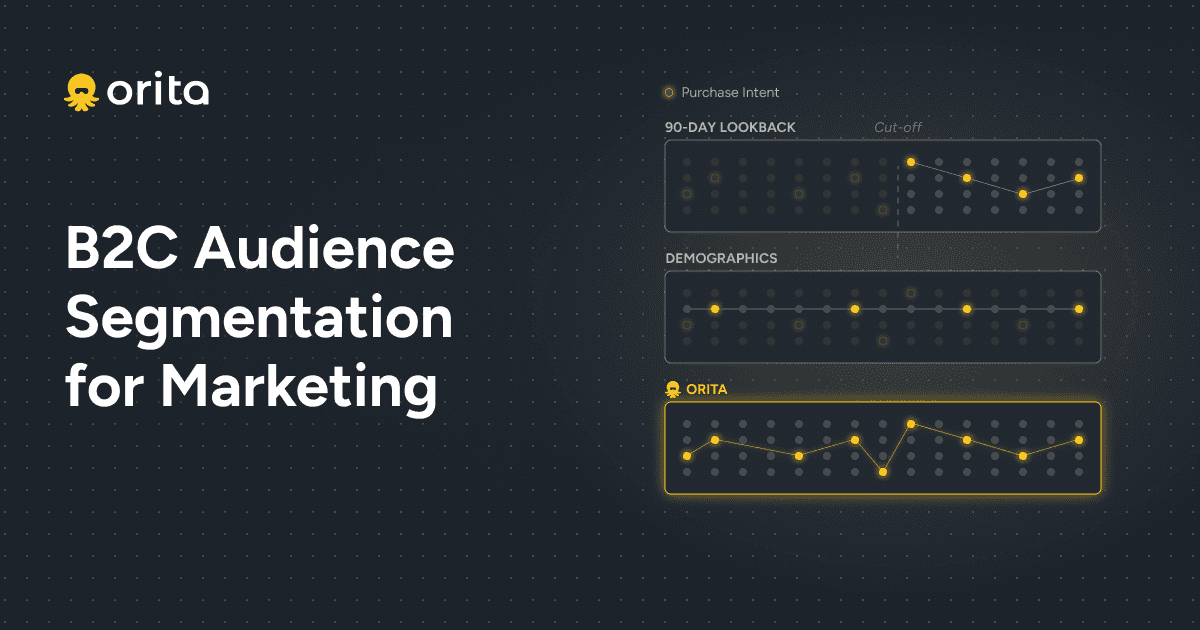
Purchase-based segmentation (RFM) relies on arbitrary cutoffs like “engaged in last 90 days,” treating someone who clicked once on day 89 the same as someone who clicked 100 times on day 91
Demographic segmentation adds context through age, location, and household data but doesn’t predict purchase intent
AI-powered segmentation analyzes hundreds of behavioral signals simultaneously to predict who’s ready to buy right now
Campaign segmentation drives 70-90% of your email volume and determines your sender reputation, making it the highest-leverage place to apply AI
Orita uses custom AI models to score customers daily for campaign sends, helping brands like Spanx see +31% campaign revenue
What Is B2C Audience Segmentation and Why It Matters
B2C audience segmentation divides your customer list into specific groups based on shared characteristics, behaviors, and purchase patterns. Instead of sending the same message to everyone, you create targeted campaigns for people who share buying habits, engagement history, or lifecycle stage.
The performance difference is measurable. Well-segmented campaigns yield more than 3x the revenue per recipient compared to non-segmented campaigns. That’s the difference between a campaign that barely moves the needle and one that drives serious revenue.
For B2C brands, segmentation determines which customers receive each campaign you send. Without it, you’re broadcasting to everyone and connecting with no one. With it, you’re targeting people most likely to respond.
The question isn’t whether to segment, but which segmentation method best predicts who will click and buy.
Purchase-Based Segmentation: The Industry Standard with Built-In Limitations
Most B2C brands start with RFM segmentation—dividing customers by Recency, Frequency, and Monetary value of past purchases. You set rules based on when someone last bought or engaged, how often they buy, and how much they spend.
A typical implementation looks like this: “Include anyone who clicked an email in the last 90 days” or “Suppress anyone who hasn’t purchased in 180 days.” These rules create clean segments that are easy to understand and simple to build in any email tool.
The limitation is in the logic itself. RFM treats engagement as binary—you’re either in or out based on fixed timeframes. Someone who clicked once on day 89 gets included. Someone who clicked 20 times but 91 days ago gets suppressed. A customer who clicked once in the last 90 days receives the same treatment as someone who clicked 100 times in that period.
These rules of thumb miss the nuance that predicts purchase intent. Engagement patterns don’t follow calendar cutoffs. A customer who browses your site weekly but hasn’t purchased in six months might be more valuable than someone who bought once 89 days ago and hasn’t engaged since.
RFM tells you what happened in the past. It doesn’t predict what will happen when you send your next campaign.
Demographic Segmentation: Adding Context Without Predicting Intent
Demographic segmentation groups customers by age, income, gender, location, education, or household size. The data is straightforward to collect and easy to act on. A skincare brand creates different messaging for customers in their 20s versus 50s. A children’s clothing retailer segments by whether customers have kids.
This adds valuable context to who your customers are. Location lets you customize for regional preferences, weather patterns, or shipping zones. Age and household data help you match product recommendations to life stage.
The limitation is the same as RFM: demographics describe your customers but don’t predict their next action. A 35-year-old in Seattle who hasn’t engaged in four months is less valuable to target than a 50-year-old in Miami who clicked yesterday, regardless of how well your messaging matches their age bracket.
Demographic segmentation layers useful information onto your campaigns. It doesn’t tell you who’s ready to buy right now.
AI-Powered Segmentation: Predicting Engagement Before Each Campaign
AI segmentation analyzes behavioral patterns too complex for manual rule-building. Where RFM segmentation relies on fixed criteria like “opened 3+ emails in 30 days,” AI models process hundreds of signals simultaneously: purchase frequency, browse depth, category affinity, email engagement, click patterns, seasonal buying cycles, and engagement decay rates.
The key difference is prediction. AI scores every customer every day, identifying who’s most likely to click or buy right now—not who met static criteria last week. As new behavioral data arrives, predictions update automatically. Dynamic segments reflect current intent rather than historical groupings.
AI finds high-intent customers hiding in your list who don’t fit standard RFM patterns. These are people who show subtle behavioral combinations that predict purchase readiness but wouldn’t qualify under rules like “purchased in last 90 days.” Manual segmentation misses them because the patterns are too nuanced to capture in static rules.
Each AI model learns from your specific customer base. What drives purchase intent for a supplement brand differs completely from a fashion retailer. Custom AI captures those unique patterns rather than applying generic benchmarks across industries.
The result: you target people based on predicted behavior, not arbitrary timeframes or demographic assumptions. This shift from “who engaged recently” to “who will engage with this campaign” drives the performance gap between traditional segmentation and AI-powered prediction.
Campaign Segmentation vs. Flow Segmentation: Understanding the Difference
Campaigns and flows serve different purposes in your email strategy, and the segmentation approach for each needs to match its role.
Flows are automated messages triggered by specific customer actions: welcome series, cart abandonment, post-purchase follow-ups, browse abandonment. They fire based on individual behavior and send to relatively small subsets of your list at any given time. Flow volume is predictable and contained.
Campaigns are one-off sends to larger portions of your list: product launches, sales announcements, seasonal promotions, content newsletters. These are the messages where you choose the audience, set the timing, and control the volume. Campaigns make up the majority of your total email sends.
Here’s why the distinction matters for deliverability and revenue: your sender reputation is determined by your total sending behavior. Because campaigns account for 70-90% of your email volume, they drive the majority of your engagement signals to inbox providers. If you’re sending campaigns to unengaged subscribers at high volume, you’re training Gmail and Yahoo to treat your domain as low-priority.
Optimizing flow segmentation improves conversion rates on those specific journeys. But optimizing campaign segmentation protects your deliverability across every message you send, including those flows. You can have perfectly tuned flows and still land in spam if your campaign volume targets the wrong people.
Campaign segmentation is where AI delivers the highest return. This is where you need daily predictive scoring to identify which customers should receive each send. This is where volume decisions compound into sender reputation. This is where targeting the wrong people destroys deliverability while targeting the right people generates revenue.
The biggest gains come from applying AI to campaign segmentation first.
The Hidden Threat: Why Bot Removal Is Essential Before Segmentation
Bots infiltrate B2C email lists through multiple entry points, and each type corrupts your segmentation in different ways.
Fake signups flood forms with generated emails that never open. Marketplace bots scrape competitor sites and subscribe using disposable addresses. List bombing attacks weaponize your signup form, submitting thousands of emails within hours to overwhelm your sender reputation. Checkout bots create accounts to scalp inventory, leaving dead profiles that look legitimate but never engage.
The damage compounds quickly. Bots inflate your list size while distorting engagement, making your campaigns appear engaging, though sales from bots never materialize. They trigger spam filters when mailbox providers detect non-existent addresses.
Bot removal must happen before segmentation, not after. Clean out non-humans first, then build segments from genuine behavioral signals. Otherwise, you’re optimizing campaigns for an audience that doesn’t exist.
How Orita’s AI Segmentation Maximizes Campaign Revenue
Orita builds a custom machine learning model for each brand using your first-party data. The model scores every customer daily, predicting who’s most likely to click or buy for each specific campaign you send.
Before segmentation begins, Orita removes bots automatically to ensure predictions are based on real human behavior, not fake engagement. This protects your sender reputation and keeps your segments clean from the start.
The AI identifies high-intent customers who don’t fit standard RFM patterns, finding revenue in segments you might have suppressed using traditional rules. Caraway rescued over $1M from dormant subscribers by targeting them the moment behavioral signals indicated renewed intent—not when they crossed an arbitrary 90-day threshold.
Orita focuses specifically on campaign-level optimization. While other tools improve flow performance, campaigns represent 70-90% of your total email volume and determine your sender reputation with inbox providers. This is where AI segmentation delivers the highest impact on both revenue and deliverability.
The platform syncs directly with Klaviyo and other ESPs, adding predictive segments to your existing tools without replacing anything. You keep your current workflows while gaining daily AI scoring that manual RFM rules and demographic filters can’t replicate.
The result: campaigns generate more revenue per send while improving deliverability. Spanx saw +31% campaign revenue and +36% click rates. Tracksmith achieved 40x ROAS on direct mail by targeting the right customers at the right time, proving AI segmentation works across channels when you identify true purchase intent.
Final Thoughts on B2C Segmentation
RFM segmentation and demographic filters provide a starting point, but they’re built on rules of thumb that miss the behavioral signals predicting purchase intent. AI processes hundreds of data points daily to identify who will respond to each campaign you send.
Your sender reputation depends on campaign segmentation because campaigns drive 70-90% of your email volume. This is where AI delivers the highest return—not just in revenue per campaign, but in protecting the deliverability that makes every email perform better.
B2C audience segmentation driven by AI prediction finds revenue in unexpected places while keeping your list healthy. Clean your list of bots, move beyond fixed timeframes, and your campaigns will perform better across every metric that matters.
FAQ
How does AI segmentation differ from using RFM scores?
RFM scores group customers by recency, frequency, and monetary value using fixed rules you set manually. Someone who clicked once on day 89 gets included; someone who clicked 20 times on day 91 gets excluded. AI segmentation analyzes hundreds of behavioral signals simultaneously—browse patterns, category affinity, engagement decay, seasonal cycles—to predict who’s ready to buy right now, updating daily as new data arrives.
Can AI segmentation work if I’m already using demographic filters?
Yes. AI segmentation layers on top of your existing demographic segments. You can still send age-appropriate messaging or location-based offers while using AI to predict which customers within those demographic groups are most likely to respond to each campaign. Orita syncs directly with your ESP without replacing any current segmentation.
What happens to my campaign performance if I remove bots before segmenting?
Your engagement rates improve because you’re targeting real humans instead of fake profiles that inflate your list size. Brands consistently see dramatic improvements in click rates and deliverability after removing bots. Spanx achieved +36% click rates by targeting actual engaged customers instead of a list contaminated with non-human interactions, while Plunge removed 5,600+ bots and saw +$224k in incremental revenue within six weeks.
Why should I prioritize campaign segmentation over flow optimization?
Campaigns account for 70-90% of your total email volume, which means they drive the majority of your sender reputation signals to inbox providers. Optimizing flow segmentation improves those specific journeys, but optimizing campaign targeting protects your deliverability across every message you send, including those flows. AI segmentation for campaigns delivers the highest return because that’s where volume and sender reputation compound.
How long does it take for AI segmentation to find revenue in dormant subscribers?
Results vary by brand, but Orita starts scoring customers daily as soon as your custom model is built. Caraway rescued over $1M from dormant subscribers by targeting them when behavioral signals showed renewed intent—not when they crossed an arbitrary 90-day threshold. Plunge saw $224k in incremental revenue within the first six weeks.