The 2025 holiday season didn’t just drive a spike in sales, it likely delivered the single biggest infusion of new value you’ll see all year. Two groups in particular represent a rare, time-sensitive opportunity:
1. First-time buyers who purchased during BFCM/December
2. New subscribers acquired during BFCM/December who didn’t purchase
Both cohorts enter your ecosystem with unusually high intent. The challenge is that this intent decays rapidly, and the window to convert them is shorter than most brands realize.
At the same time, this also creates the most fragile deliverability conditions of the year. So the real question becomes:
How do you reach these high-value profiles aggressively enough to convert them, without worsening inbox placement when your reputation is already unstable?
The answer lies in segmenting them intelligently and sequencing your sends using a drafting strategy that works with inbox algorithms - not against them. Luckily, we can help (and already have - check your Klaviyo account!).
The 60-Day Intent Window You Can’t Ignore
For first-time buyers, the period immediately after their initial purchase is the highest-probability moment you will ever have to drive the second sale. That second purchase is where LTV acceleration begins.
Likewise, new subscribers who joined during BFCM are still in a high-interest state. They may not have converted yet, but they signaled intent by opting in during the most promotionally charged moment of the year.
Across both groups, intent is at its peak right now, and it decays sharply over the next 60 days.
Every week you wait erodes revenue you can never fully recover.
Why You Can’t Just “Blast Everyone” After the Holidays?
Here’s the complication:
BFCM tends to dent deliverability for nearly every brand.
During the sale window, brands dramatically expand their reach. They mail deep into their list, including profiles they rarely message. That surge in volume and riskier audience mix often results in:
Lower inbox placement
Higher filtering
Depressed open rates
Reputation volatility that carries into December and January
A broad blast to your entire BFCM cohorts at once can push your reputation further down just when you need reliability the most.
That’s why protecting deliverability isn’t optional if your goal is to maximize post-holiday revenue.
How Orita Engagement Levels Give You Immediate Control
Orita’s Engagement Levels offer a simple but powerful way to isolate the right profiles at the right time.
By combining this property with holiday-specific filters, you can quickly create two targeting ladders. The Orita team has started to build these for you today, so you can begin using immediately:
1. First-time buyers by engagement level
2. New subscribers (prospects) by engagement level
These engagement ladders let you tier your BFCM-acquired profiles from safest-to-message to riskiest.
That structure is exactly what enables the next step: using “drafting” to maximize inbox placement.
The Drafting Strategy: Reach More People Without Damaging Your Reputation
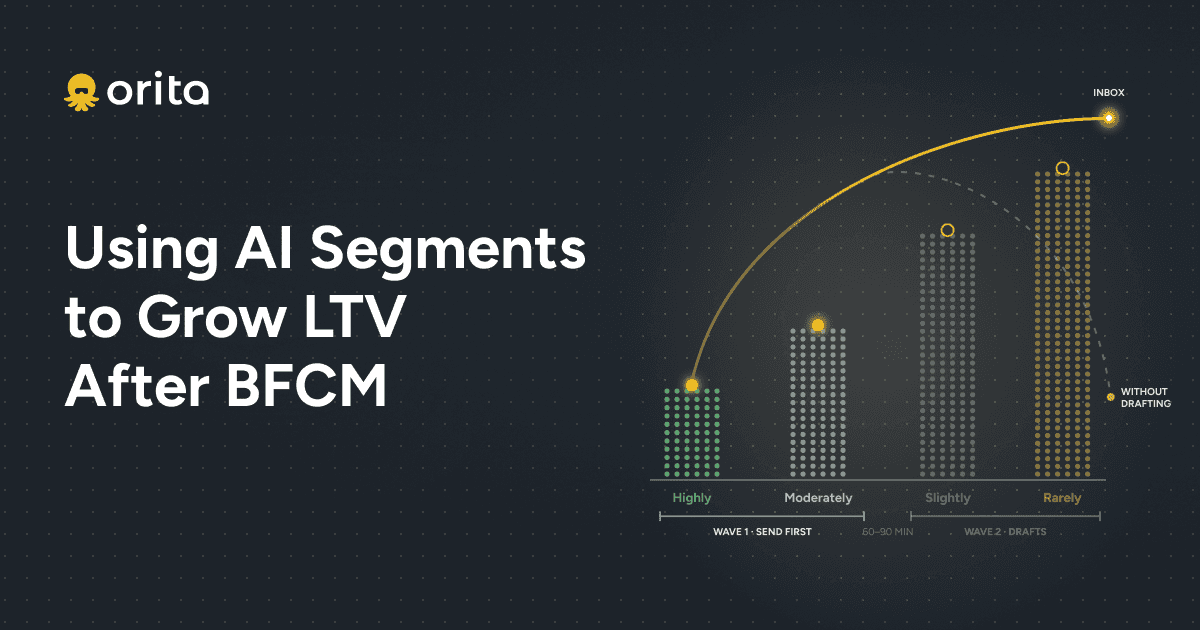
The drafting strategy is simple: instead of sending to everyone at once, you work with inbox algorithms to build positive signal early in the day, then “draft” off that momentum to reach harder-to-place audiences.
Here’s how it works:
1. Start With Your Highest-Engagement Segments from the Holidays
You’ll see new segments labelled:
Orita: Holiday First Time Buyers - Highly Engaged
Orita: Holiday New Prospects - Highly Engaged
These segments include First time buyers or subscribers who were added to your list in November or December of 2025
Your Highly Engaged and Moderately Engaged holiday profiles should be the first to receive your campaign. These subscribers are the most likely to open and click, which sends strong positive signals
2. Wait 60–90 Minutes
This brief pause is the engine of the drafting effect. Inbox providers register the strong performance of your first wave and adjust your sender scores upward in real time.
3. Monitor Performance by Engagement Tier
Evaluate performance by tier so you know exactly how far down the engagement ladder you can safely go.
Key metrics you’ll want to track are:
Click Rates: we suggest sending to these segments until the click rate on these segments falls below your rolling 30-day average
Unsubscribe: aim for 0.3% or better
Spam Rates: target 0.01% or better
If your lower-engagement audiences behave safely, you can continue to target these profiles with subsequent campaigns, and add lower-engagement segments in the next send.
If not, you tighten up on the next cycle and remain with your higher-engagement tiers.
This approach turns a historically risky moment into a controlled, predictable send strategy
4. “Draft” Behind That Positive Signal, adding less engaged segments
Now you send to the next tier: your Slightly Engaged and Rarely Engaged holiday profiles.
Because the earlier engagement was strong, this second wave benefits from better inbox placement than it would have received on its own.
A quick note on what to send to these segments
Orita’s really great for deciding who to send to, which we think is often more important than what you send.
You might want to reiterate your welcome offer, but this approach can also work with whatever campaign content you’re sending out already.
A Safer, More Revenue-Dense Post-Holiday Strategy
When you pair BFCM acquisition, Orita’s Engagement Levels, and the drafting strategy, you create a system that:
Accelerates second purchases and converts more new subscribers
Protects inbox placement during a sensitive period
Turns post-BFCM instability into LTV growth
This is the most controlled, adaptive, and revenue-efficient way to work your BFCM cohorts, without sacrificing deliverability when it matters most.
NEED HELP?
If you don’t see segments in your Klaviyo account, it’s likely due to having an older connection to Orita that’s API vs OAuth. This is an easy fix, please email cs@orita.ai for next steps.