Long gone are the days of sending the same email to your entire list and hoping for the best. Now, Klaviyo ROI tools use machine learning to score every contact daily based on their actual behavior, automatically moving them into high-intent or at-risk segments. You get to message people when they’re ready to buy and give the rest a break, which means better inbox placement, healthier lists, and way more revenue without adding hours to your workweek.
TLDR:
AI tools for Klaviyo predict purchase intent and protect deliverability beyond native features
Orita builds custom ML models on your data to identify high-intent buyers and remove bots daily
Post Pilot automates direct mail, Maverick creates personalized videos, Mailmend targets Gmail tabs
Brands using AI segmentation send fewer emails while increasing revenue per campaign by 30%+
Orita syncs predictive segments to Klaviyo automatically without replacing your existing workflow
What Are AI Tools for Klaviyo?
Think of Klaviyo as the high-performance engine of your retention marketing. AI tools for Klaviyo are the specialized tuning kit that makes that engine run at peak efficiency. While native features handle general tasks beautifully, third-party apps operate like medical specialists—a cardiologist versus a general practitioner. These integrations overlay advanced models on your historical data to solve problems humans simply can’t manage manually, like predicting precise purchase timing. This helps you escape the batch-and-blast trap, protecting your sender reputation and unlocking the full potential of your list.
How We Ranked AI Tools for Klaviyo
We ignored shiny interfaces to focus on the hardest workers. You need software that respects your workflow while squeezing more juice out of every campaign. Here is the rubric used to grade the contenders:
Integration Depth: The tool must sync directly. If you have to manually upload CSVs, it is not helpful.
Measurable ROI: Email generates an average return of $36. Any add-on must prove it creates incremental revenue above that baseline.
Segmentation Precision: We prioritized predictive models that analyze first-party data over generic rule-based grouping.
Deliverability Impact: We looked for tools that actively defend your sender reputation.
Low Lift: We ranked plug-and-play capability highly. You should not need a data scientist to get started.
Best Overall AI Tool for Klaviyo: Orita
Orita acts as a specialized intelligence layer sitting on top of your Klaviyo. We don’t replace Klaviyo; we make it smarter. Instead of relying on generic segmentation rules, we build custom models trained strictly on your brand’s first-party data. By analyzing complex behavioral patterns daily, our AI predicts exactly who is ready to click or buy and who is about to unsubscribe. These precise segments auto-sync directly into Klaviyo, allowing you to message the right people without manual guesswork or hiring a data science team.
Key features:
Custom Models: We predict purchase intent and churn risk using your unique data rather than broad industry averages that might not apply to your customers.
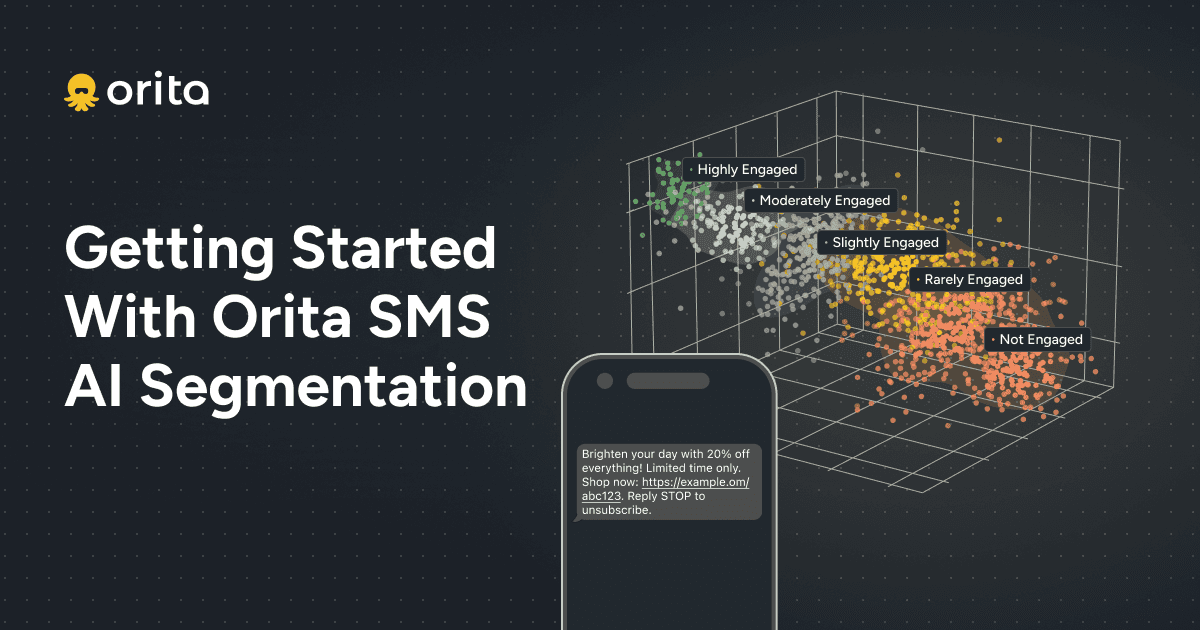
Daily AI Scoring: Every contact gets scored every day, automatically moving them into high-intent or at-risk segments that sync to Klaviyo in real-time.
List Health Automation: We identify and remove non-human bot traffic to repair your sender reputation and secure better inbox placement.
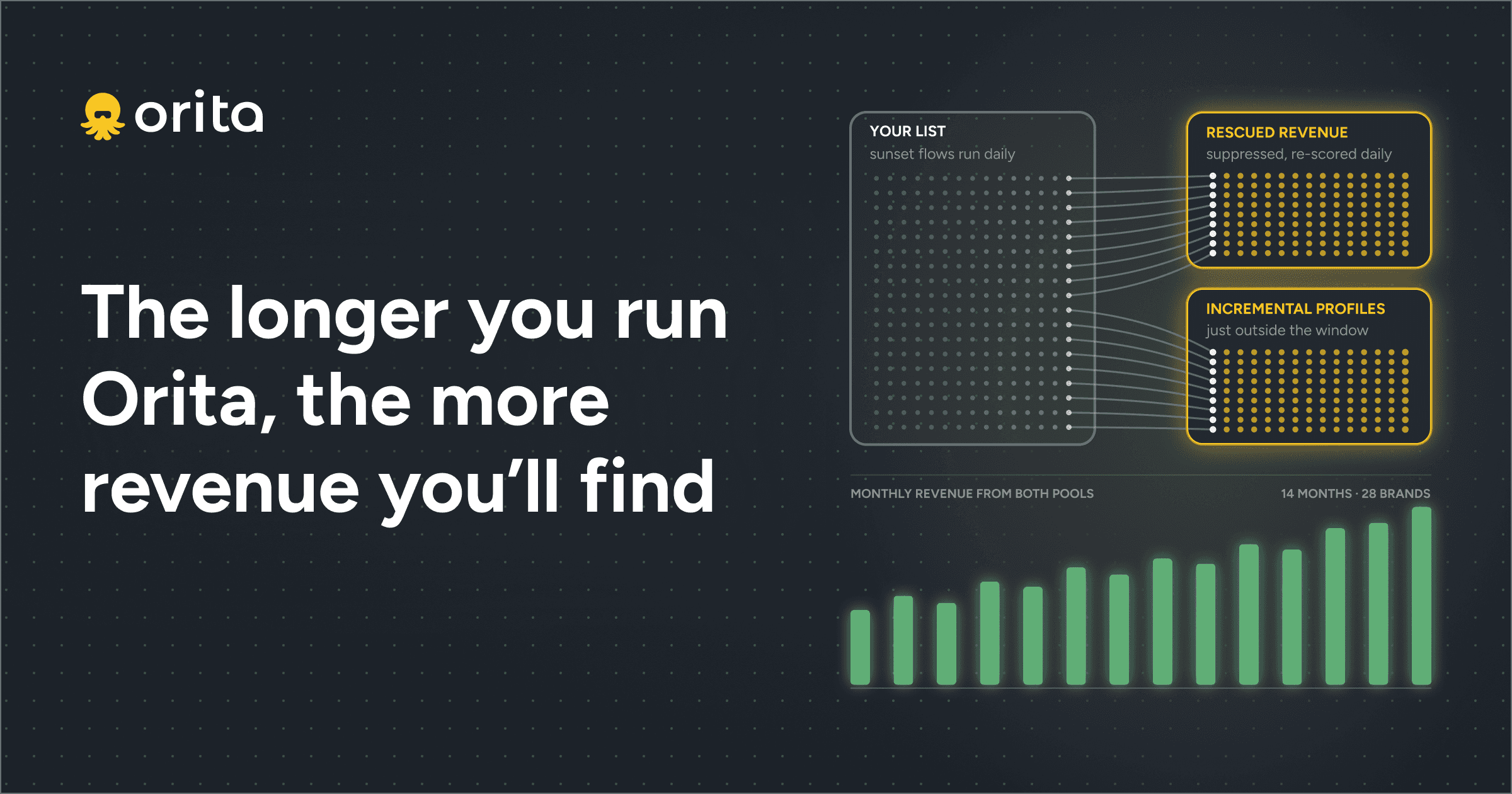
Rescued Revenue: Our models find valuable buyers hiding in your suppressed or inactive lists, reactivating them the moment their buying signals change.
Good for: Ecommerce brands with large subscriber lists looking to fix deliverability issues or increase revenue per campaign. It fits teams who want enterprise-grade data science without the heavy lifting.
Limitation: Works best for brands already generating consistent email volume and events; very early stores with sparse data will see less lift until more behavior accumulates.
Bottom line: Orita serves as an additive layer that makes Klaviyo perform better. We tell you exactly who to message to drive measurable lift, so you stop leaving revenue on the table.
Klaviyo Marketing Analytics
Klaviyo Analytics is the native reporting and insight layer inside Klaviyo, giving a baseline view of performance, attribution, and predictive metrics without leaving the platform. It aggregates opens, clicks, conversions, and customer value to show which flows and campaigns are working.
Key features
Revenue attribution, cohort reporting, and predictive metrics like expected CLV and churn risk based on account data.
Built-in dashboards that benchmark growth and retention across segments and time periods.
Good for: Teams that want strong diagnostics and performance overviews directly in Klaviyo and are comfortable translating charts into manual segmentation and strategy changes.
Limitation: Great at describing what happened, but it doesn’t automatically create daily predictive segments; marketers still have to operationalize insights into targeting rules themselves.
Bottom line: Klaviyo Analytics sets the baseline; Orita sits on top to turn those behavioral patterns into real-time segments you can send to with minimal manual work.
Nosto
Nosto is a commerce experience platform that uses AI to personalize product recommendations, content, and merchandising across your entire site and email campaigns. While it’s primarily known for on-site personalization, its Klaviyo integration brings those same intelligent product recommendations into your email flows.
Key features:
AI-powered product recommendations that analyze browsing and purchase behavior to suggest the most relevant items for each customer in real-time.
Dynamic content blocks that automatically populate emails with personalized product grids, trending items, or category-specific recommendations without manual updates.
Cross-channel consistency that ensures customers see coherent product suggestions whether they’re browsing your site or reading an email.
Good for: Brands with large product catalogs who want to automate merchandising decisions in email. It fits teams looking to increase average order value through smarter product discovery without manually curating every campaign.
Limitation: Nosto excels at showing the right products to people who are already engaged, but it doesn’t predict who should receive emails in the first place; it optimizes content, not audience selection.
Bottom line: Nosto perfects what customers see in your emails; Orita determines which customers should receive those emails based on their likelihood to engage and purchase.
Revamp
Revamp is a CRM and personalization platform built specifically for Shopify brands, using AI to create hyper-personalized customer experiences across email, SMS, and on-site interactions. It combines customer data platform capabilities with automated segmentation to deliver tailored messaging at scale.
Key features:
Unified customer profiles that consolidate data from Shopify, email, SMS, and browsing behavior into single actionable records.
AI-driven personalization engine that automatically customizes product recommendations, messaging, and offers based on individual customer preferences and behavior patterns.
Automated journey orchestration that triggers personalized campaigns across channels based on customer lifecycle stage and predicted actions.
Good for: Shopify brands wanting an all-in-one personalization layer that handles both data unification and campaign execution. It fits teams looking to consolidate multiple tools into a single platform.
Limitation: Revamp focuses on personalizing the message and journey once you’ve defined your audience, but it doesn’t specialize in the daily predictive scoring that identifies exactly who is ready to buy right now versus who needs a break.
Bottom line: Revamp creates personalized experiences for your segments; Orita builds the precise, predictive segments that tell you who should receive those experiences for maximum ROI and deliverability protection.
Maverick
Maverick automates personalized video at scale by letting you record a core clip once while its AI customizes name and details for each recipient, creating a one-to-one feel in email. It boosts engagement by adding a “human” touch without manual production overhead.
Key features
AI-personalized video generation that drops unique-looking clips into email flows.
Scalable production that turns a single recording into thousands of individualized greetings.
Good for: Brands wanting to elevate key flows—welcome, post-purchase, abandonment—with personalized video that stands out in crowded inboxes.
Limitation: Focuses on creative output and doesn’t analyze your list or deliverability; it needs strong segmentation from tools like Orita to ensure videos go to the right recipients.
Bottom line: Maverick perfects the creative; Orita decides which segments should get that premium content for maximum impact and minimum deliverability risk.
Mailability.io
Think of Mailability as an automated assistant for your Klaviyo account. It uses AI to identify shoppers who have drifted away and triggers specific messaging flows to win them back. This reduces the manual setup required to build complex revenue logic.
Key features:
Autopilot AI framing designed to speed up revenue in existing flows.
Targeting based on intent signals from shoppers showing interest again.
Packages specifically built for automated revenue growth.
Good for: Teams wanting flow logic without heavy configuration. It fits if you are okay with a “black box” style of management.
Limitation: Only works for flows. Because the logic is automated, you lose transparency. You get less visibility into decisions compared to tools that show you exactly how segments are defined.
Bottom line: Mailability automates re-engagement flows. Orita pairs well with this by providing the precise, transparent audience definitions you need to keep strategic oversight.
Mailmend
Getting stuck in the Promotions tab is frustrating. Mailmend is designed to help your emails jump the fence into the Primary inbox. It focuses on specific Gmail placement tactics to signal that your campaign is personal correspondence rather than a standard marketing blast.
Key features:
Placement mechanics aimed at shifting emails to the Primary tab.
Testing tools specifically for Gmail tab categorization.
Formatting adjustments designed to influence inbox algorithms.
Good For: Brands looking for a quick fix to prioritize immediate visibility in Gmail.
Limitation: Some tactics involve adding non-standard text to bypass filters. While this often boosts short-term open rates, it can confuse customers. There is also the potential long-term reputation issues if email providers catch on to this hack.
Bottom Line: Mailmend targets the inbox algorithm; Orita targets the customer relationship. We focus on engagement-based segmentation to ensure you land in the inbox because your audience truly wants to be there.
Monocle
Monocle is an AI-powered personalization platform that analyzes customer behavior to deliver individualized product recommendations and content across email, SMS, and on-site experiences. It focuses on understanding each shopper’s unique preferences to create tailored shopping journeys that feel custom-built rather than mass-marketed.
Key features:
Behavioral AI engine that learns from browsing patterns, purchase history, and engagement signals to predict what each customer wants to see next.
Real-time personalization that adapts recommendations instantly as customer behavior changes, ensuring emails always feature the most relevant products.
A/B testing automation that continuously optimizes recommendation algorithms to improve conversion rates without manual intervention.
Good for: Brands with diverse product catalogs who want to move beyond basic “you might also like” suggestions into truly individualized merchandising. It fits teams looking to increase conversion rates through smarter product discovery.
Limitation: Monocle excels at personalizing what products to show engaged customers, but it doesn’t determine which customers should receive communications in the first place or predict who’s about to churn versus who’s ready to buy. It also focuses on flows more than campaigns.
Bottom line: Monocle optimizes the shopping experience for customers in flows; Orita identifies exactly which customers belong in campaigns to help bring more qualified customers into your flows.
Why Orita Is the Best AI Tool for Klaviyo Users
Klaviyo gives you the engine, but you still need to decide where to drive. We built Orita because generic “smart sending” algorithms usually aren’t smart enough for high-volume brands. Your store is unique, so we build a bespoke model trained strictly on your actual data rather than applying broad rules that might work for a tire shop but fail for a fashion brand.
We score every contact on your list daily and sync those audiences directly to your Klaviyo account. This tells you exactly who is ready to buy and who needs a break. You improve deliverability by mailing the right people, and you stop wasting money annoying the ones who aren’t interested. It creates a healthier list and better margins without adding more work to your plate. We do this one specific thing—AI customer segmentation—and we are really, really good at it.
Final Thoughts on AI Tools That Work With Klaviyo
Your retention marketing gets better when you add AI tools for Klaviyo that focus on one thing and do it exceptionally well. Generic segmentation rules can’t keep up with the nuances of your customer base, so predictive scoring makes the difference between batch-and-blast and precision targeting. Orita handles that daily scoring and syncs those audiences directly to your account, so you message the right people without the manual work.
FAQs
How do I choose the right AI tool for my Klaviyo account?
Start by identifying your biggest pain point: if deliverability is suffering, prioritize tools that clean your list and improve sender reputation; if you’re leaving revenue on the table, look for predictive segmentation that identifies high-intent buyers; if engagement is flat, consider creative tools like personalized video. Match the tool’s core strength to your most pressing problem, and remember that the best stacks layer multiple specialists rather than relying on one solution.
Which AI tool works best for brands just starting with advanced segmentation?
Orita is built for teams who want enterprise-grade segmentation without hiring data scientists. Our models require zero technical setup and sync segments directly into Klaviyo within days. If you’re already comfortable with flows and want to automate re-engagement logic, Mailability.io offers a faster plug-and-play approach, though with less transparency into how decisions are made.
Can I use multiple AI tools together, or will they conflict?
Most of these tools solve different problems and work beautifully together. For example, Orita identifies your highest-intent segments, Post Pilot sends those segments physical mail, and Maverick creates the personalized video content that goes in your emails. The key is ensuring each tool has a distinct job—one for audience intelligence, one for creative execution, one for channel diversification—so they complement rather than duplicate effort.
What’s the difference between predictive segmentation and standard Klaviyo segments?
Standard Klaviyo segments use rules you define manually (like “opened in the last 30 days”), which work well for basic grouping but miss nuanced behavioral patterns. Predictive segmentation builds custom machine learning models trained on your specific customer data to forecast who will buy next or who’s about to churn, catching signals that fixed rules can’t detect—like a customer whose purchase cycle is 47 days instead of the standard 30.
How quickly can I expect to see ROI from adding an AI tool to Klaviyo?
Most brands see measurable lift within the first month. Orita clients typically spot incremental revenue in their first full campaign cycle (often 2-4 weeks), while deliverability improvements from bot removal can show up in your Klaviyo dashboard within days. Tools focused on creative execution like Maverick may take slightly longer to test and optimize, but engagement metrics usually improve within the first few sends.