Tie is a deanonymization tool that recently added a profile scoring feature, Tie Predict. Orita only does AI customer segmentation, using deep ML expertise to score each profile based on likelihood to engage and answer: who actually wants to hear from you today.
Let's get into how these two are different.
Feature | Orita | Tie |
|---|---|---|
Primary focus | AI Customer Segmentation (it's all we do!) | Anonymous visitor identification, with scoring added recently |
Optimizes for | Engagement: who on your list wants to hear from you today | Reach: your list, plus re-identified anonymous shoppers, with scoring to help mitigate deanonymization risks |
Sender reputation | Enhances it by reaching profiles most likely to engage | Adds poorer quality profiles to your active list, that then need to be managed to avoid sender reputation damage |
Track record | 200+ brands, multiple years, Klaviyo's Premier Partner for Segmentation | Tie Predict is newly launched. Tie's deanonymization has been around for longer (formerly Revenue Roll) |
Results | 30% email campaign revenue lift, 26% email click rate lift, 31% revenue per SMS lift | No comprehensive results shared. Case studies with unclear measurement methodologies |
Proves results with | A/B tests and holdouts, with proof across hundreds of customers | A test that layers Tie on top of an Orita segment |
TLDR
Tie is a deanonymization tool that added segmentation and scoring later to handle the cold traffic that deanonymization adds.
Orita does one thing: predict who on your list wants to hear from you today. Orita does this with deep expertise in Machine Learning that is difficult to replicate.
The people Tie adds to your active profile count with deanonymization never opted in. By definition they want to hear from you less than people who have opted in.
Orita has 200+ brands and years of holdout-tested results.
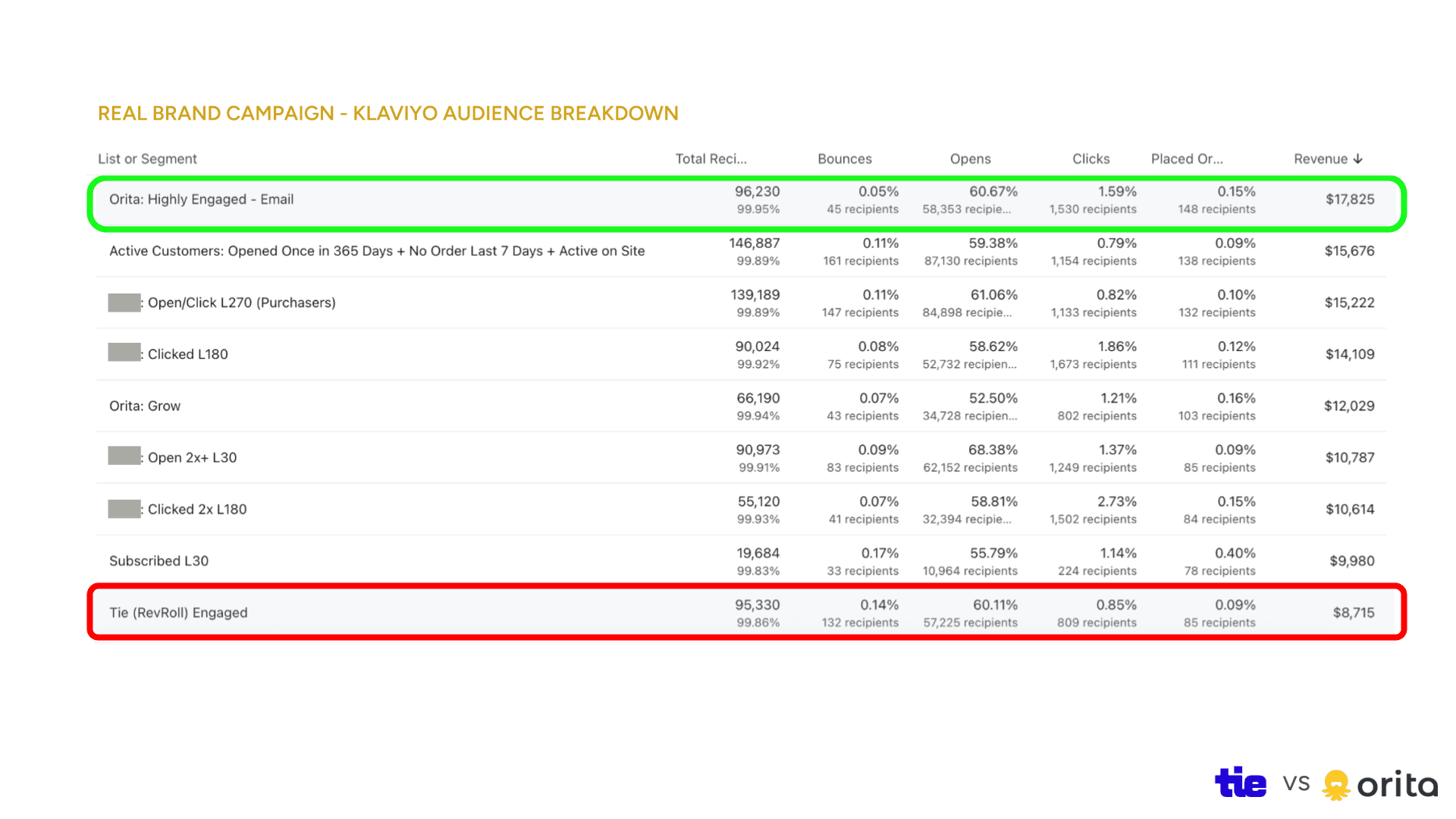
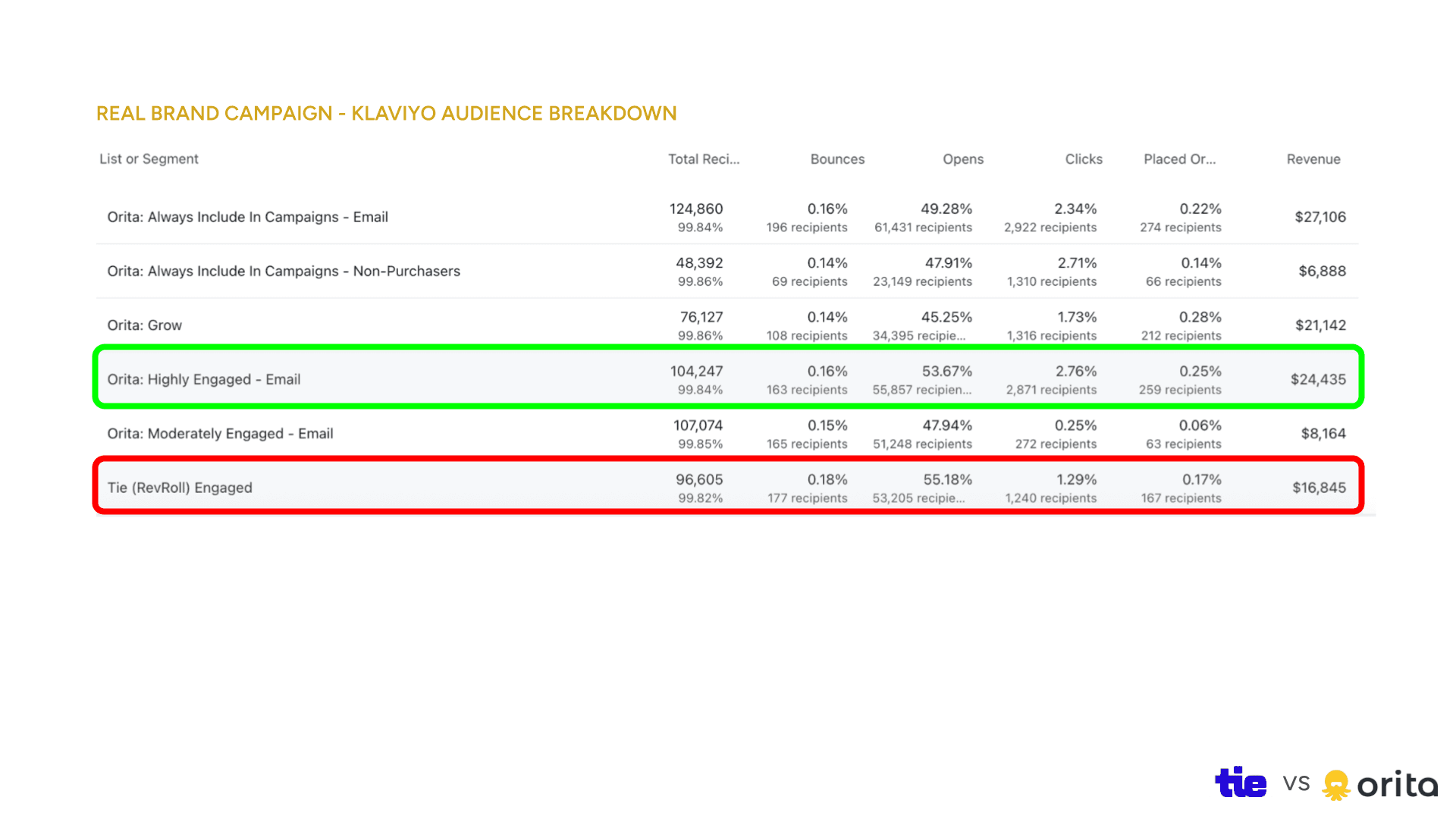
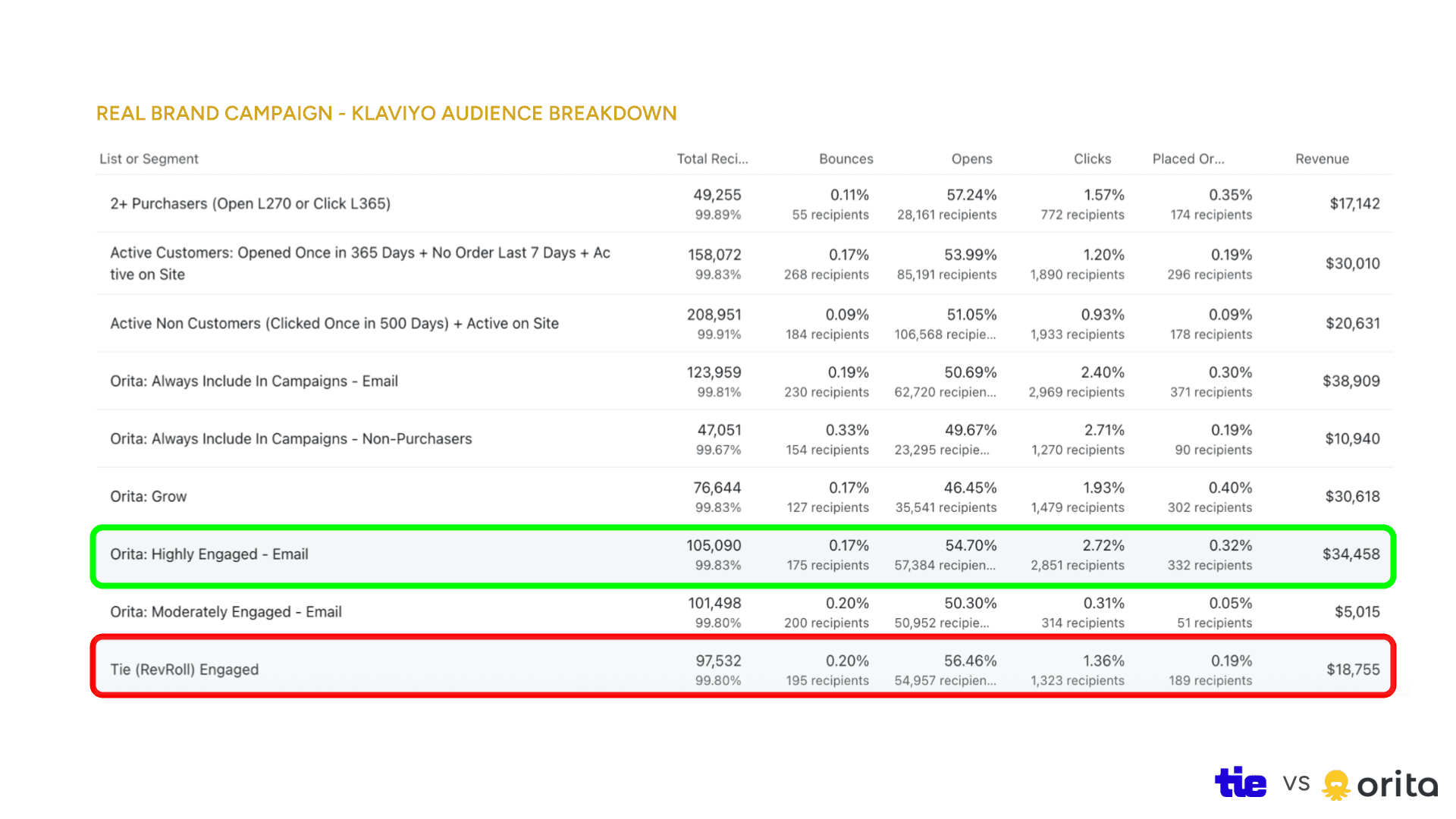
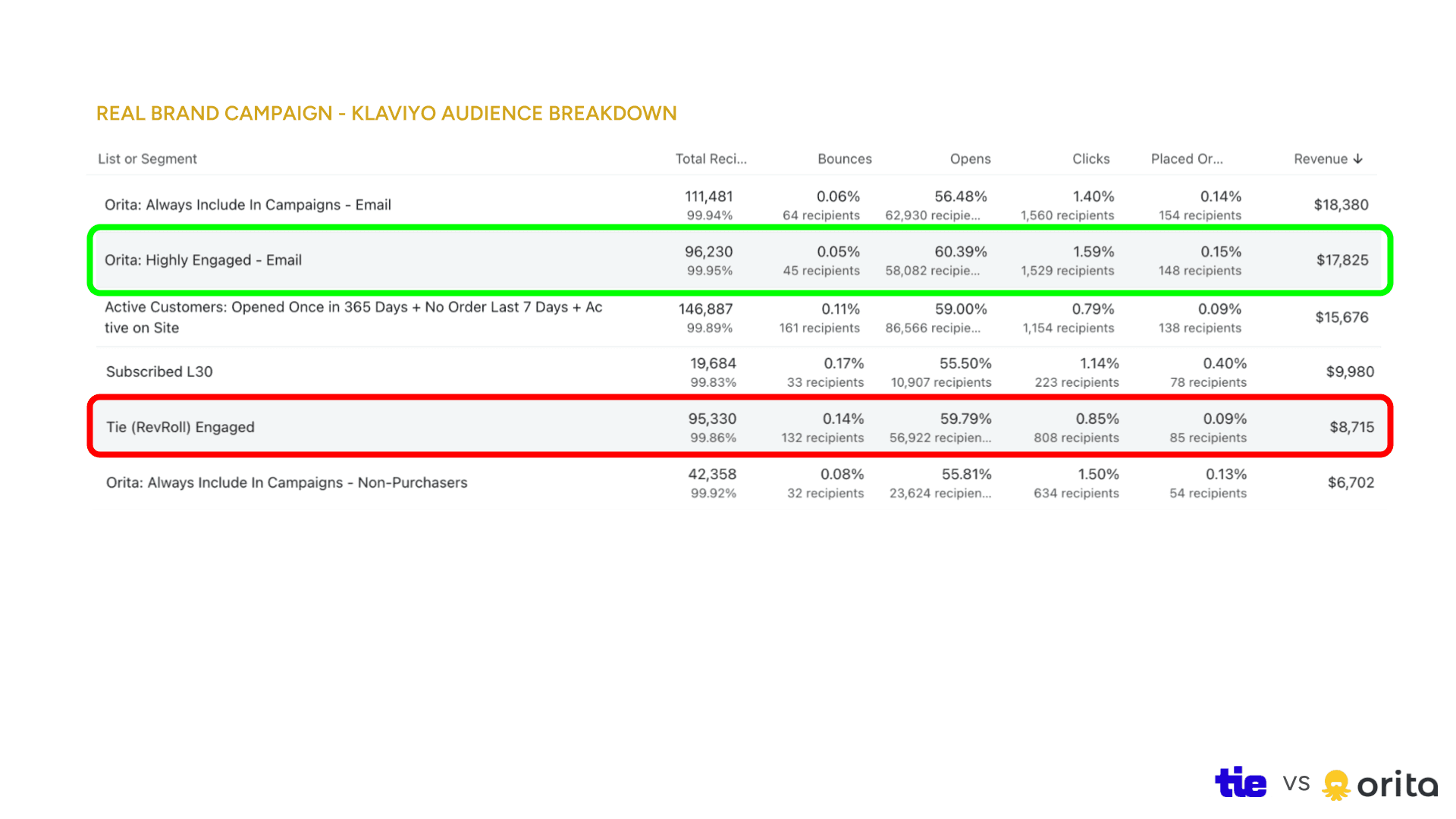
Brands who have tried both companies' scores see a clear winner with Orita.
What Tie is built to do and does well: deanonymization
Tie (formerly Revenue Roll) is a deanonymization tool. It spots the anonymous visitors on your site and matches them to a real profile. That's hard engineering, and they're good at it.
Tie Predict, the layer that drops purchase, open, and click scores onto your Klaviyo profiles, came later. It sits on top of that identity matching feature. Predicting engagement is a different and very difficult problem. While it makes sense that it is valuable to add engagement scoring on top of deanonymization (deanonymization can add low-intent profiles to your Klaviyo list), it's not easy to do this with a high degree of accuracy.
Why a deanonymization tool needs a scoring layer
When your core product adds deanonymized strangers to a brand's active Klaviyo list, you create a problem: most of those people never asked to hear from the brand. They browsed once and got matched. Now something has to decide which of them is safe to email. That's the job the score is doing.
So the scoring isn't really the point of the product. It's a patch for the cold audience deanonymization drags in.
That matters, because a segment is only ever as good as the pool it's drawn from. Score a cold list well and you still have a cold list. You can't model your way into someone wanting to hear from a brand they never signed up for.
Orita starts with the people who chose you
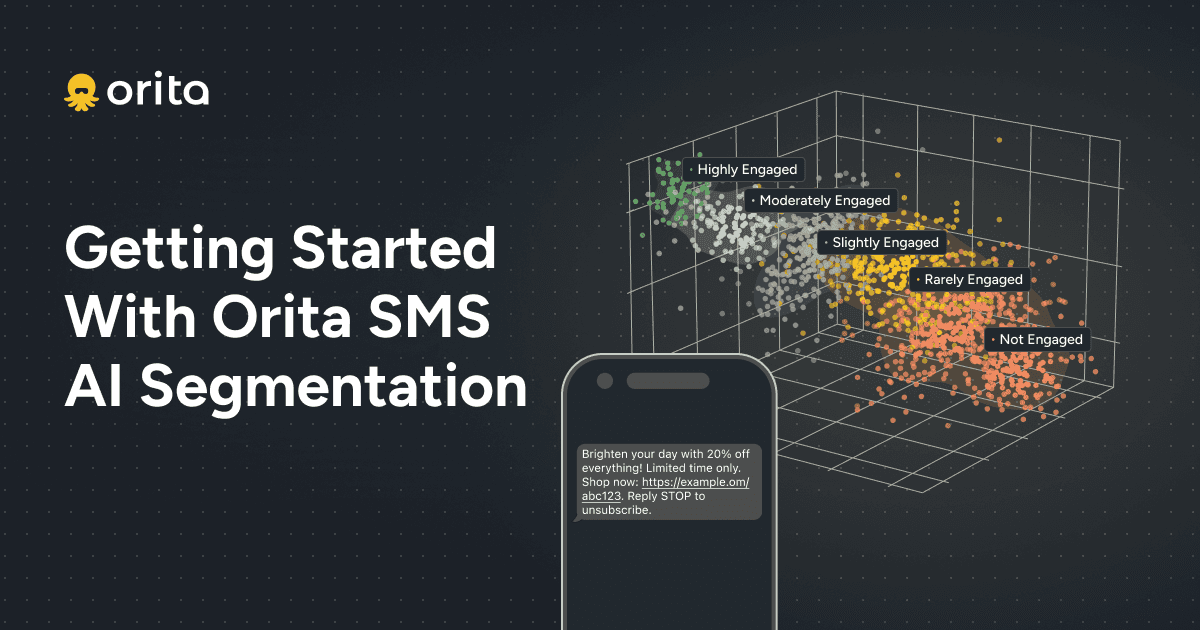
We skip that problem by starting from the other end. We build a model for your brand, trained on your first-party data, and score every profile, every day, to find the customers most likely to buy now, including the dormant ones a rule of thumb would miss. The segments sync into Klaviyo, ready to send.
Built by ML scientists who do only this
Two of our co-founders are Machine Learning experts with advanced degrees and over 10 years in eCommerce. Half our team is ML, data, and analytics people who work on nothing but segmentation. Predicting who wants to hear from you today is hard, mathy work, and it's the only work Orita does. That focus results in better predictions, and better outcomes for brands.
Proven across 200+ brands, not one campaign
Across 200+ brands and multiple years, our customers average 30% more campaign revenue, 26% higher click rates, and a 31% lift in revenue per recipient on SMS. That's why Klaviyo has named Orita a Premier Partner for segmentation, the highest tier in their ecosystem, held by a handful of partners.
Tie Predict launched recently, so its track record is very short.
Be wary of confusing methodologies
There's a specific move worth watching for in comparisons against Orita.
A tool takes one of our segments, layers its own score on top to filter it down, and reports a higher placed-order rate as proof it improved on Orita. But that test never shows the tool's own segment. By measuring its score only as a filter on our list, it hides the audience that tool would have picked on its own, which would likely include plenty of people Orita never counted as engaged. Layering on top of our segment borrows our audience quality and quietly keeps theirs out of view.
A real head-to-head settles it: put each tool's own segment in a campaign and compare clicks, orders, revenue, and efficiency.
And judge by clicks and revenue, not opens, since too many opens today aren't real people.
Deanonymization and segmentation are different jobs
These are two different jobs, and the right tool depends on which one you need.
If you want deanonymization, identifying the anonymous visitors on your site, there are several options: Tie, OpenSend, Elevar, and others built for exactly that.
If you want the best segmentation, knowing which of your customers wants to hear from you today, that's what Orita is built for, and the only thing we build.
Want to see it on your own data? Start with a free audit or book a demo, and put our segment up against anyone's.
FAQ
What is the difference between Orita and Tie?
Tie is a deanonymization tool: it identifies anonymous website visitors and matches them to profiles, with a scoring layer (Tie Predict) added on top. Orita is an AI Customer Segmentation tool: it builds a model on a brand's first-party data and predicts which profiles are most likely to engage or buy. Tie focuses on adding people to a list. Orita focuses on choosing who to send to.
What is Tie Predict?
Tie Predict is the scoring layer Tie added on top of its deanonymization product. It assigns daily purchase, open, and click scores to Klaviyo profiles, using Tie's identity graph alongside a brand's own data.
Does Orita identify anonymous website visitors?
No. Identifying anonymous visitors is deanonymization, which Orita does not do. Tools like Tie, OpenSend, and Elevar focus on that. Orita works on the profiles a brand already has, predicting which ones want to hear from it.
Can a brand use Orita and Tie together?
Yes, because they do different jobs. A brand could use a deanonymization tool to identify anonymous visitors and use Orita to decide which profiles to include in a given campaign. They are not substitutes for each other on their core functions.
Which is better, Orita or Tie?
It depends on the job. For identifying anonymous traffic, Tie and other deanonymization tools are built for that. For segmentation, knowing which customers want to hear from a brand today, Orita is the focused, specialized option.