There's a worry we hear a lot, usually from a smart marketer who's been burned by a "shiny new tool" before: doesn't this just work for a few months and then flatten out? Then there’s the holiday-specific version: isn't this really just a BFCM trick?
Fair questions. Lucky us, we’re a team full of ML engineers, data engineers, and data scientists so, yeah, we have answers
We looked at the group of brands that came on board with Orita between June and September 2025, and tracked what happened every month since, through August 2026. That's 14 months of data across 28 active brands. Long enough to see past the "new tool" bump and into the part that actually matters: does the impact hold, and why?
Two pools of revenue, refreshed every month
There are two distinct pools we’re looking at, and both of them refill on their own as people’s preferences - and engagement - change
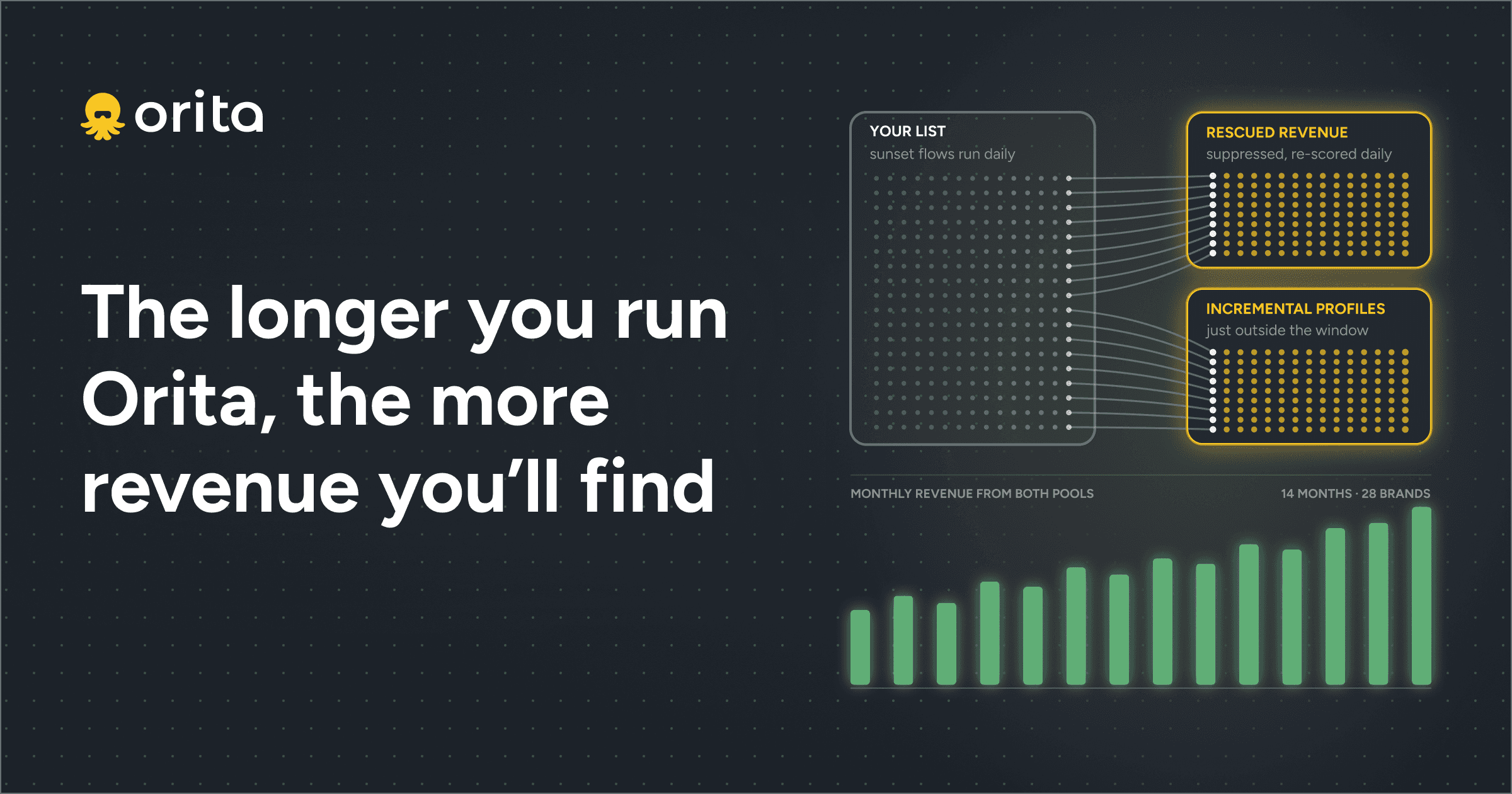
Rescued Revenue™. This is revenue from profiles Orita reactivates off a brand's Manually Suppressed list, the profiles that got pushed there by a sunset flow or a round of list cleaning. Many brands appropriately add to these lists monthly or quarterly: people go quiet, sunset flows do their job, and the Manually Suppressed list grows. Orita re-scores that list every morning and finds the folks who are actually ready to hear from you again. Here’s a blog post if you want to learn more about Rescued Revenue™
Incremental Profiles. This one's subtler, and just as valuable. Say a brand only emails people who've engaged in the last 90 days. Anyone who clicked 91 days ago is invisible to that send, even if they're still a good customer. When Orita adds that person into a day's send and they buy, that's an incremental profile: someone the brand's own rules would have skipped, converted anyway.
Both pools exist because engagement windows and sunset flows are built on fixed rules, just like they were 15 years ago. But, um, real customers don't follow fixed rules. Someone drifts past the 90-day mark this week; someone else gets sunset next week. Your opportunity doesn't run dry because the reasons people fall out of an active list never stop happening.
Yes, the holidays help. No, they're not the whole story
We're not going to pretend November and December don't matter. They do. Holiday lift for this cohort runs about 2x versus the spring baseline, and November alone hit a single-month peak of $353K in rescued revenue.
But 2x on top of a real, sustained baseline is very different from 100% of your rescue happening in six weeks and nothing the rest of the year. In a typical off-peak month, this cohort still rescues between $150K and $210K. Not in the first month, not in the best month: in an ordinary month. The holidays are a lift, not a lifeline.
$40M in Rescued Revenue™ and counting
We’ve saved over $40M for our customers in Rescued Revenue™. Across the cohort in this analysis, from June 2025 through July 2026, we found them to $2.17M in Rescued Revenue™, i.e. sales from prospects they thought were “dead contacts”. This number keeps going up since this cohort is still enrolling new brands each month). That's real revenue from customers a static list would have already written off.
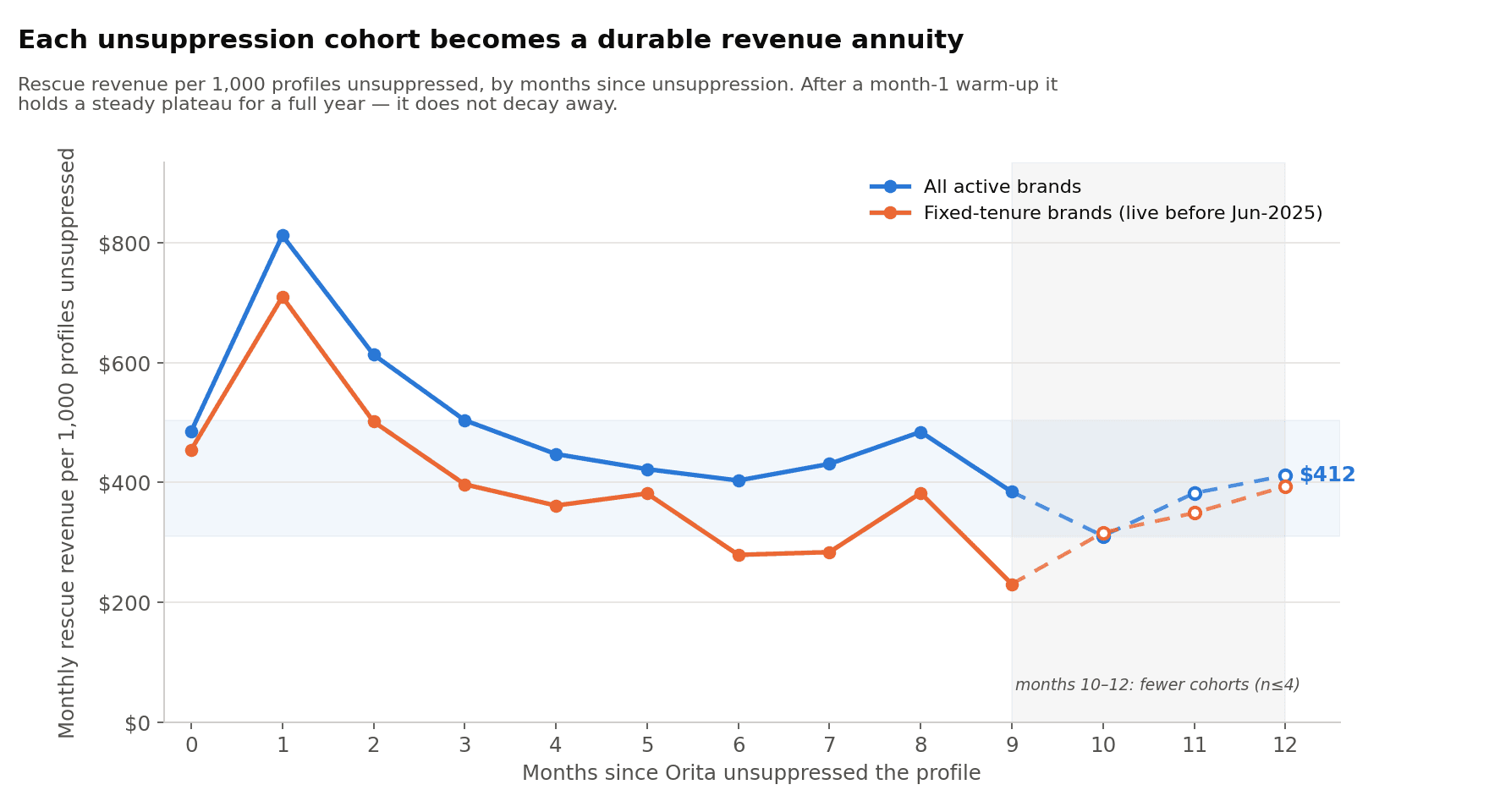
You can see that the curve flattens out, it doesn’t die, so the direct impact compounds.
But wait, there's more: the “At bats” you don't see on the scoreboard
Here's the part that's easy to undercount. When we measure Rescued Revenue™ and incremental profiles, we're using a brand's own attribution window: a purchase within, say, 1 or 5 days of a click. That's the conservative number, and it's the one in the stats above.
But a click or a site visit that doesn't convert inside that window isn't nothing. It's a customer back in your catalog, looking around. Some of them buy later and get attributed to a different channel entirely: Meta picks up the credit, or they finish the purchase on Amazon, or they walk into a store. We call these at bats. We can't always prove the hit, but we know we got someone back up to the plate. On the margin, more clicks and more site visits from people who'd otherwise never see your emails again is good, full stop.
Being empathetic to when your customers want to hear from you improves your performance, and makes all of your paid $$$ go further too
Orita is both a seasonal nice-to-have or a real and an ongoing compounding machine. Orita’s impact spikes at the holidays because more of your customers are shopping then. At the same time, the AI customer segments keep your list healthy, and keep compounding the rest of the year, because suppressed lists keep growing, engagement windows keep cutting people off, and Orita never stops finding the ones worth another swing.
FAQs
What is Rescued Revenue™?
Rescued Revenue™ is revenue from customers sitting on your manually suppressed list who bought after Orita brought them back into your active list.
Does Rescued Revenue™ drop off after the first few months?
Nope. We consistently see Rescued Revenue™ for brands using Orita. There may be more in November / December you will continue to see Rescued Revenue™ month over month.
Is Orita just a Black Friday or holiday email tool?
No. Holidays give a real lift, about 2x the spring baseline.
How much revenue is sitting in a suppressed email list?
It depends on how big your list is and how aggressively you've suppressed, so nobody can quote you a real number sight unseen. We can run an audit to give you a sense for your opportunity size.
Is it safe to email people on your manually suppressed list?
Never email someone who has a negative consent status, e.g. they’ve written in “unsubscribe me”. Aside from that, it’s certainly safe to email people on your Manually Suppressed list when you're selective about it. The risk in reactivating a manually suppressed list is emailing all of it at once, which sends a wave of non-engagement to inbox providers and drags on your sender reputation. Orita scores every manually suppressed profile daily and surfaces only the ones predicted to engage, so the people coming back into your sends are the ones most likely to open, click, and buy. Everyone else stays quiet until they're ready.
How is this different from a win-back or sunset flow?
Most sunset flows and win-back campaigns run on fixed rules: no opens in X days, one last email at day 90, then the profile moves to suppressed. Those rules do a real job, but they don't know anything about the individual behind them. Orita scores each profile every day against actual behavior, so someone who's genuinely ready comes back this week instead of waiting for the next quarterly cleanup. We also have a feature for flows like Win-back, so you know exactly who should go into each flow to maximize revenue.
Why does a 90-day engagement window cost you revenue?
Because customers don't shop on a 90-day clock. An engagement window protects your deliverability by keeping quiet profiles out of your sends, and it also hides good customers who happen to be one day past the line. More people age out of that window every single day.
What is an "at bat" in email marketing?
An “at bat” is traffic to your site, whether or not that traffic converts. It's the value we don't officially count. Rescued Revenue™ is measured inside your own attribution window, say a purchase within 1 or 5 days of a click. That's the conservative number, but it misses the clicks and site visits that don't convert right away. Those customers are back in your catalog looking around, and some buy later through a different channel, like Meta, Amazon, or in a store, where the credit lands elsewhere. We call that an at bat: we can't always prove the hit, but we know we got someone back up to the plate.
Will this same pattern show up on my list?
Every list is different, but the mechanism doesn't depend on your industry or your season. If you have a suppressed list, there is likely to be some opportunity in there. We can help you understand the size of this opportunity with a free, quick, Klaviyo email engagement audit.