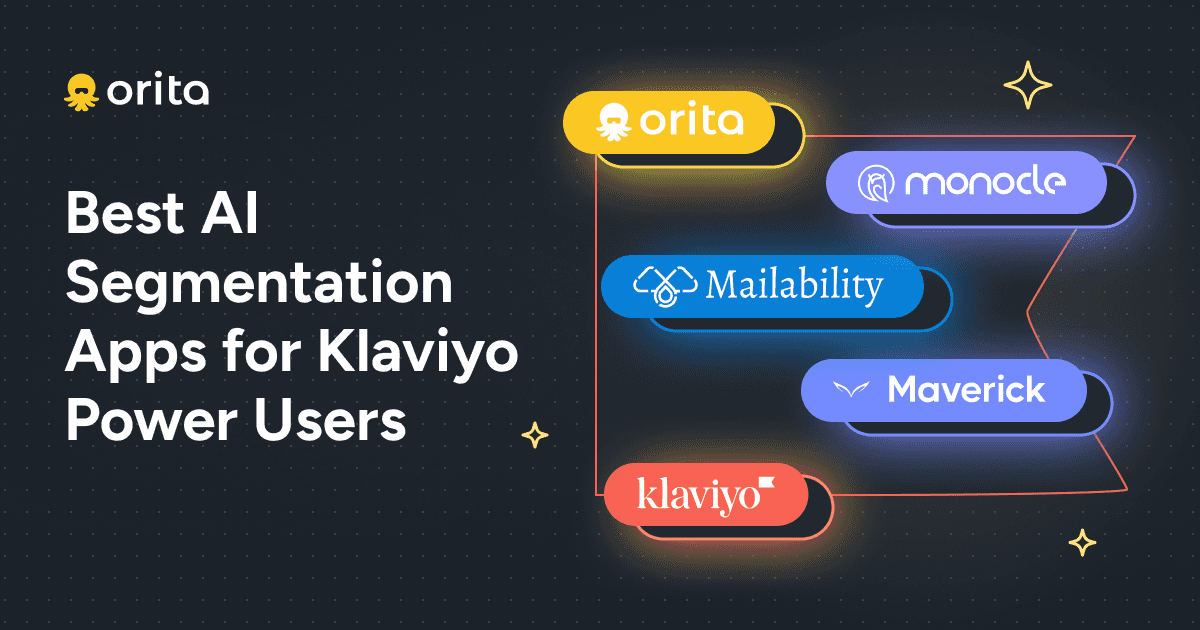
Most Klaviyo users hit a point where historical segments stop capturing everyone ready to buy. You start looking for Klaviyo segmentation enhancement options that use predictive models instead of rigid rules. The problem is that every app markets itself as AI-powered, but some just automate flows while others actually forecast future behavior. We compared the tools that go beyond basic RFM analysis so you can see which ones deliver real intelligence and which ones are just repackaging features you already have.
TLDR:
AI segmentation apps predict future behavior vs. static rules, finding high-intent buyers missed by time-based filters
Orita builds custom ML models from your data, helping brands like Spanx boost revenue 31% and Caraway rescue $1M from customers other segmentation tools had missed.
Most tools automate flows or creative; Orita identifies which customers to message before they enter those flows
Key features to prioritize: native Klaviyo sync, predictive scoring, bot removal, and automated segment updates
Orita uses custom machine learning to predict purchase intent and protect deliverability without replacing Klaviyo
What Is AI Segmentation for Klaviyo?
Think of traditional segmentation like driving with a paper map. You check past clicks and purchases to guess where a subscriber is going. It works, but it relies on rigid history.
AI acts like a GPS. Instead of static rules, the best Klaviyo AI tools analyze data to predict future behavior, reassess constantly based on changing conditions, and assign a probability score to every person on your list.
While native features are strong, dedicated apps for Klaviyo segmentation enhancement model this data to find hidden revenue.
You identify folks ready to buy who might technically fall outside a “30-day active” window. In fact, advanced segmentation can drive a 760% increase in revenue compared to basic non-segmented campaigns.
You stop guessing and start mailing with precision, keeping your sender reputation healthy.
How We Ranked These AI Segmentation Apps for Klaviyo
Finding the right software for Klaviyo segmentation enhancement shouldn’t feel like a second job. While 90% of marketers report that segmentation improves email performance, only 31% of businesses currently use advanced segmentation beyond basic demographics, creating a significant competitive advantage for early adopters.
We reviewed feature sets and API docs to find apps that act as a turbocharger for your existing stack. We focused on these specific requirements:
Native Integration: The app must sync data directly via API. If it breaks your current flows or requires hacky workarounds, it’s out.
Predictive Smarts: We looked for actual machine learning that forecasts behavior, distinct from basic historical rule-sets like standard RFM.
Deliverability Support: The tool needs to protect your sender reputation by actively filtering out risky contacts.
Revenue Recovery: It should spot high-intent buyers hiding in your suppressed lists so you don’t leave money on the table.
Total Automation: Segments must update automatically. If you have to manually upload a CSV file, it didn’t make the cut.
Best Overall AI Segmentation App for Klaviyo: Orita
Orita positions itself as an AI segmentation engine purpose-built for Klaviyo users, designed to uncover revenue that generic rules and time-based segments miss. Instead of relying on broad industry patterns, it builds a custom model on each brand’s first-party data to predict who is ready to buy, acting as a smart intelligence layer on top of Klaviyo’s sending infrastructure.
What they offer:
Custom models built from your specific data rather than generic industry patterns.
Daily scoring that automatically creates and syncs dynamic segments directly into Klaviyo.
Bot removal and deliverability protection that improves inbox placement.
Rescued revenue from dormant segments by identifying customers showing renewed intent signals.
Zero system changes required, allowing it to work alongside Klaviyo instantly.
Good for: brands using Klaviyo that want more precise, revenue-focused segmentation—especially those with large lists where traditional time-based or rule-based segments have plateaued.
Limitation: best suited for data-rich Klaviyo accounts; smaller lists or early-stage brands with limited engagement history may see less lift from advanced modeling.
Bottom line: Orita adds an intelligence layer on top of Klaviyo, turning raw engagement signals into high-intent segments that standard rules overlook, helping brands unlock incremental revenue from customers they might otherwise ignore. Klaviyo users leveraging AI-powered marketing tools report 41-50% higher email open rates and 24-40% increased campaign revenue per customer.
Monocle
Monocle functions as an AI agent for your marketing channels, focusing intensely on the individual level. It coordinates the customer journey across email, SMS, and onsite interactions to hit the right timing for every person automatically.
What they offer
Automates timing and channel selection for individual journeys
Injects personalized offers and discounts directly into flows
Selects creative assets on a 1:1 basis across touchpoints
Good for: brands that want to optimize flows across email, SMS, and onsite journeys, especially for scenarios like cart and browse abandonment.
Limitation: focuses on flows, missing out on bigger opportunities from campaign segmentation.
Bottom line: Monocle excels at individualized post-action orchestration, while Orita widens the engaged audience first by identifying high-intent customers that standard segments overlook.
Maverick
Maverick takes a creative angle on personalization. Instead of predictive analytics, it uses AI to generate personalized video content for email campaigns. You record one video, and the tech automatically adjusts the audio and lip movements to speak each customer’s name. It makes mass marketing feel like a direct message.
What they offer
Generates personalized video content where the AI speaks individual customer names
Automates video production to scale 1:1 messaging across large lists
Provides a unique creative format to increase click-through rates
Creates content variations without requiring hours of manual filming
Good for: Brands that want to stand out in the inbox with highly personalized, video-based emails that feel like 1:1 messages at scale.
Limitation: Focuses on creative assets rather than segmentation strategy.
Bottom line: Maverick makes personalized video content that boosts engagement, while Orita determines which customers should receive that content to drive the most revenue impact.
Mailability.io
Mailability positions itself as an automated teammate for your marketing stack. It focuses on taking the manual work out of setting up flows and identifying user intent, effectively putting optimization on auto-pilot.
What they offer
Automated creation of flows and segments
Targeting based on shopper intent signals
Hands-off revenue acceleration features
Good for: Teams that want a fully hands-off approach to flow optimization, letting the system auto-create journeys and target based on intent.
Limitation: Operates like a black box, reducing visibility into why decisions are made and making it harder to audit, learn from, or replicate the logic manually. Focuses on flows, leaving lots of revenue on the table for campaigns.
Bottom line: Mailability maximizes automation and convenience, while Orita delivers transparent, precise segments that marketers can understand, adjust, and control within their broader strategy.
Klaviyo Marketing Analytics
Klaviyo Marketing Analytics operates as an embedded intelligence module within your dashboard. It moves beyond basic reporting to visualize attribution and benchmarks directly in your workflow, helping you understand performance without leaving the ecosystem.
What they offer
RFM Action Center with automated retention recommendations
Custom benchmarking and attribution modeling
Predictive analytics to map customer journeys
Pricing starts as a paid add-on at $100 per month
Good for: Brands that want native, Klaviyo-hosted intelligence with RFM-based insights, benchmarks, and attribution directly inside their existing dashboards.
Limitation: Standard RFM logic can blur the line between customers who are simply between purchase cycles and those who have actually churned, risking premature suppression of still-valuable profiles.
Bottom line: Klaviyo Marketing Analytics surfaces powerful historical and behavioral data, while Orita adds significant predictive horsepower, analyzing millions of intent signals and behavioral patterns—so brands keep high-potential customers active instead of sidelining them too early, and find more ‘needles in the haystack’ in riskier audiences.
Feature Comparison Table of AI Segmentation Apps for Klaviyo
Seeing the options side-by-side clarifies which tech handles the specific heavy lifting your strategy needs. While some apps focus on generating creative assets, others specialize in list hygiene or deep analytics.
The breakdown below compares these tools on critical capabilities like custom modeling, frequency of updates, and mulit-channel support. This helps you determine if you need a creative assistant or a data scientist working in the background of your Klaviyo account to drive retention.
Feature | Orita | Monocle | Maverick | Mailability.io | Klaviyo Analytics |
|---|---|---|---|---|---|
Custom ML Models | Yes | No | No | No | No |
Daily AI Scoring | Yes | Yes | No | Yes | No |
Bot Removal | Yes | No | No | No | No |
Goes Beyond RFM | Yes | Yes | No | Yes | No |
Multi-Channel Support | Yes | Yes | No | No | Yes |
Why Orita Is the Best AI Segmentation App for Klaviyo
Most tools for Klaviyo segmentation enhancement tweak subject lines or adjust specific flows. Orita is different. We solve the foundational problem of email marketing: knowing exactly who to message and when.
Even with the recent rollout of Klaviyo’s next-generation analytics features, reporting is only as effective as the data feeding it. We act as a dedicated intelligence layer, cleaning your list of bots so you can focus on real humans.
Bespoke Models for Precision
Generic algorithms often treat a t-shirt brand the same as a furniture retailer. We build custom machine learning models trained strictly on your first-party data. This allows us to identify high-intent buyers based on your specific customer behaviors, finding revenue opportunities that standard RFM models miss.
Sustainable Growth
Some of the best AI apps for Klaviyo rely on technical tricks to bypass spam filters. We focus on long-term domain health. By suppressing low-quality contacts and reactivating dormant customers showing real intent, we help you send fewer emails while making more money.
Final Thoughts on Enhancing Your Klaviyo Segmentation
Picking the best AI apps for Klaviyo comes down to what you need fixed first. Some brands need better creative, others need cleaner lists, and many just need to know who to email. Your sender reputation and your revenue both depend on precision. The tools exist, and your data is ready.
FAQs
How do I choose the right AI segmentation app for my Klaviyo account?
Start by identifying your biggest pain point: if you’re losing revenue to over-suppression or missing high-intent buyers, look for tools with custom predictive modeling and rescued revenue features. If you need creative engagement, prioritize video or content generation tools. Match the tool’s core strength to your specific bottleneck rather than chasing the longest feature list.
Which AI tool works best for brands just starting with advanced segmentation?
Klaviyo Marketing Analytics is a solid entry point since it’s native to your existing dashboard and builds on familiar RFM concepts. However, if you’re already seeing deliverability issues or have a large suppressed list, you’ll need a tool like Orita that goes beyond historical patterns to predict future behavior and protect sender reputation from day one.
Can I use multiple AI apps together, or will they conflict with each other?
You can layer tools that serve different functions—for example, using Orita for audience intelligence and segment creation while Monocle handles post-action flow orchestration, or Maverick generates personalized video content. The key is ensuring each tool has a distinct role in your stack so they complement rather than duplicate each other’s work.
What’s the difference between custom ML models and standard RFM segmentation?
RFM (Recency, Frequency, Monetary) scoring groups customers based on past behavior using fixed rules that treat all brands the same way. Custom machine learning models analyze your specific customer patterns to predict future actions, distinguishing between someone temporarily between purchases and someone who’s actually churned—a nuance that generic rules consistently miss.
How long does it take to see results from AI segmentation tools?
Most tools sync and start scoring within days, but meaningful revenue lift typically appears in 2-4 weeks once you’ve run campaigns with the new segments. Bot removal and deliverability improvements often show up faster—sometimes within the first few sends—since you’re immediately cutting low-quality contacts from your campaigns.